Sunday, March 10, 2013

Sprung Out and Thai-d Up


Wiping my nose, JeenHae planting flowers
Happy Spring Everyone! The warm weather is beginning. All week I have been walking to morning exercise in slippers without socks. From here the possibilities are endless. Despite this turn of good fortune, this week on the farm has been a rough one.

The warm weather also brought pollen and lots of new work to do on the farm. The combination of the two have worn me down. I've spent all week squinting through swollen, itchy eyes, sneezing loudly, and blowing snot like a water hydrant. Luckily, even in my allergy induced stupor, I was still able to finish all the work that needed doing before we left for Thailand.

I spent most of the week finishing up a new trellis system for the Kiwi orchard. I got to use lots of tools and skills I've never used before in that way. Big cables, metal cutters, giant wire clippers, an arc welder, and—of course the classic do it yourself resources—concrete and rebar. Part of me enjoyed the break from humble hand weeding, sowing, and sorting, but I also wondered if there was a more natural way to give the kiwis something to climb. I guess we'll just leave that experiment for our future farm.

The new spring work includes sowing spring vegetables that will get us through to summer: stem onions, cabbage, chrysanthemum, and lettuce. Some we sow directly in the field while others, we start as seedlings in the green house.
Stomping leaves in hot bed #2

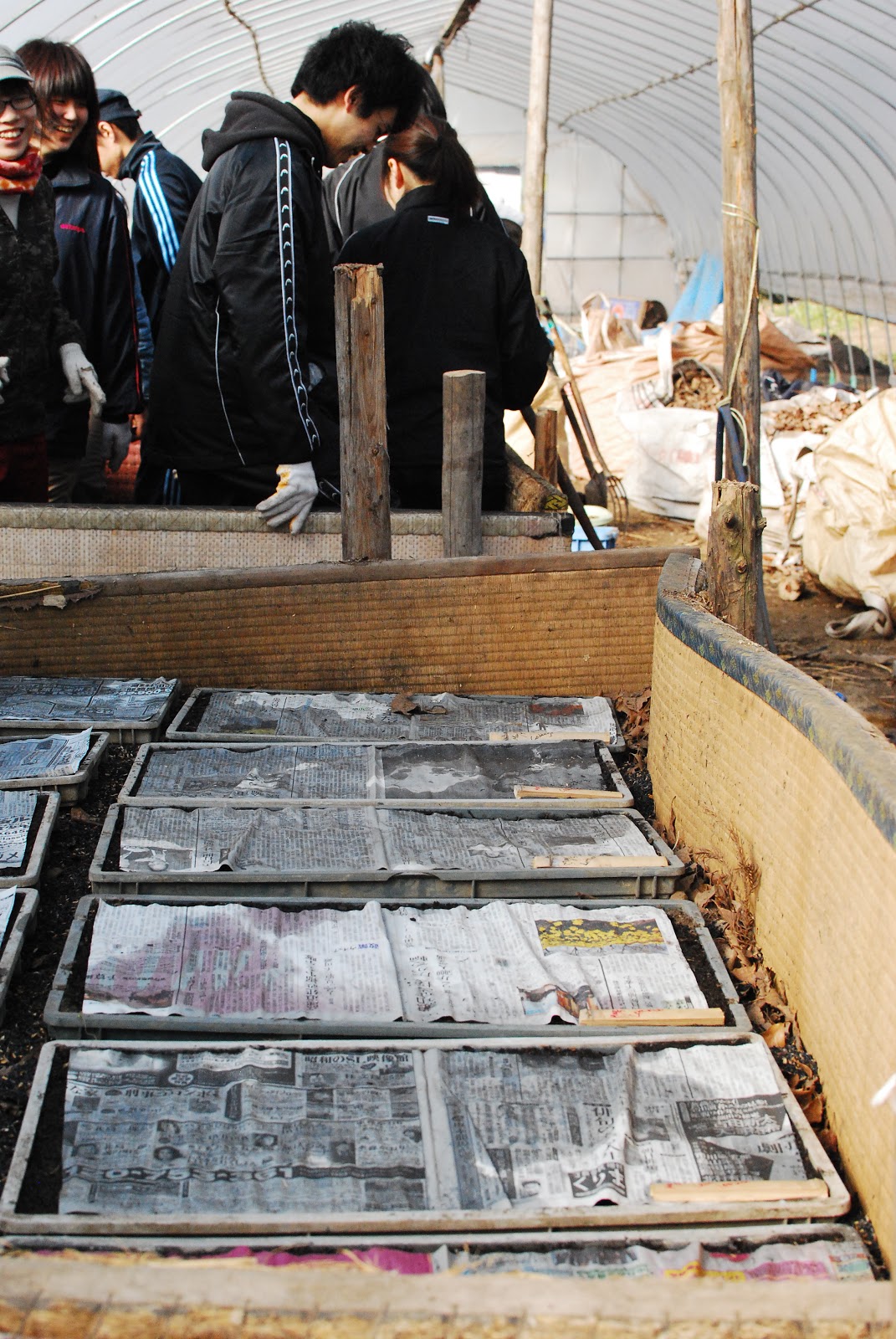
We make hot beds for these seeds. Back in the fall the volunteers spent many long hours raking up leaves around campus. I am glad to see that this is not for aesthetic purposes. We make hot beds with them. All the leaves are packed into a makeshift compost bin we construct from old rice straw mats. It stands about waist high in the green house. We add a little bacteria and give them all the resources they need for a population boom (rice bran for food, chicken manure for even more food, and water for hydration) and we just have to wait a week. Much like our bokashi, this box packed with leaves starts to give off some serious heat from all of the biotic action going on inside. We then sow our trays of seedlings and set them on the hot bed so they can get the heat they need to germinate early.


Egoma Oil
Another interesting continuation of work done in the fall is our egoma oil. Our green house was full of egoma plants all through November and into December. The volunteers spent our rainy days in there threshing the seeds out of each plant. Since then we have spent the winter sorting the seeds through various water, wind, and sifting processes. Finally we got nine bags of seed and sent them out to be pressed for oil. Last week the oil returned and we are going to be able to sell each bottle for 3000 yen, because it is really pure.

We also picked up our soy sauce from the small company that made it for us, using our harvest of black soybeans and wheat.

We are looking ahead to a time of change this month, not only in the weather but in our community as well. Of course we'll be saying hello to a whole new class of participants at the end of this month. Unfortunately we'll be saying goodbye to many people who have been a constant presence in the ARI community since Jenny and I arrived here.

Steven Cutting is moving to Kyushu with his family. He has two lovely daughters, Sarah and Ellie, who we've grown very fond of. Steven has taken us on hiking adventures and opened his home to american movie night several times. He has been a real warming presence here. Plus he is the only other tall blond guy that lives here! With him around I feel less like a big tower of white.


Gussan is the farm manager. His wife and his two-year-old daughter live an hour away on another organic farm. They are very dedicated to this lifestyle and to teaching it to others. Gussan commutes to ARI by 6:30 AM every day and sometimes doesn't leave until 5, 6, or 7:00 PM. But now he and his wife are finishing up their farm work on this side of Japan. They will move this month to Western Japan where they will start their own farm in an old and rural Japanese village. His knowledge skill and unshakable calm will be missed here.

Volunteers, Megumi and Sakura, will also be leaving us this month. We celebrated their work at ARI this week by eating out at a Chinese restaurant. Megumi is always excited about what is going on around her and her energy will surely be missed. Sakura has just turned twenty. She graduated from an agriculturally based high school before she came to ARI so she knows as much as the staff, about chickens especially. But she is never pretentious about her knowledge. Sakura is always willing to calmly discuss the method of work and its purpose, even to ask Gussan time and time again for clarification.

Recently we have taken a break in Thailand. After the long week a get away is nice. We'll tell y'all all about it next week. For the time being, just know that we are enjoying the warm weather and fresh fruit!

Peace be with you,

Doug and Jenny Knight

Sunday, March 3, 2013

Love from Tokyo

Our train made it to port at approximately 8:30pm Friday evening. By the time we surfaced from the chaotic waters of Asakusa Station, it was more like 8:35pm--we had 25 minutes to make it to our hostel before they locked the doors on weary, late-arriving travelers. It was raining. We did not bring an umbrella.

Doug took the lead dashing towards green-lit men signaling our crossing. We splashed past familiar torii and made our way down dark closing alleys. Shop keepers turned out lights and pulled down garage doors while we stomped in puddles. Three right turns make a left.

We consulted our soggy map and it told us in a drunken stupor that we were not where we needed to be. Retracing our steps, cutting out the unnecessary (now) left turns, we were back at the station. 8:47pm.

Don't cross the red bridge, go down and cross the blue bridge. Crossed blue bridge. Take the right from the Mercedes Benz building. The immediate right or the far right? Far right. There will be a small liquor store on the left and Samurai will be the right. No liquor store. Revisit Mercedes, she's a nice gal after all. 8:55pm.

Lights are on 2 blocks down. The familiar Asahi vending machine clues us in. We look right and see foreign women wheeling their rolling suitcases, this must be it. Samurai warmly welcomed us. No longer being rained on. 8:58pm.

9:38pm, venturing out to find dinner, not raining. 9:49, fine as wine dining on street kababs. We love kebabs.

With no obligations until noon the next day, we slept incredibly well that night. Saturday brought sunshine, sunshine and wind. Oh my was it windy. We ventured out to climb the tallest tower in the land (world, actually, tallest tower in the world), Tokyo Skytree, sitting pretty at 634m. The wind said "no." Skytree was closed to its non-reserved audience. Maybe next time.

So we found an amazing playground instead where we could pretend to climb the tower and also go up spiral staircases and slide down on rolling bars.


This was the beginning of our weekend in Tokyo. We were visiting Sanichi Anglican Church to talk about our YASC program and to freshen up our Episcopal/Anglican liturgy. We met up with Rev. Seraphim Ken Takashi and he showed us around Ueno Park and the surrounding historical district. We walked down roads we never would have thought to walk down by ourselves. We saw really old houses and shops and Ken explained about how people like to keep potted plants and small gardens in the alleyways because they do not have room otherwise to grow plants. These were not your typical overflowing trashcanned and graffitied alleyways, they were really beautiful.


Ken took us out to lunch and showed us a really special time. While we were walking about we were even invited inside a home for a "tea ceremony." We were informed that this is not actually an accurate description or translation, so we just call it 茶の湯 chanoyu. This was a really unique experience, both for us and for Ken. To be invited inside off the street for tea like that was really special.

Rev. Ken!
That evening we met up with the Goto family. They graciously hosted us for, what we at ARI call, a "home-stay." We shared a lovely meal, which included both Japanese and Western dishes (meatloaf!), oishikatta. We are so grateful for their hospitality, thank you, thank you, thank you! Arigatou gozaimashita

Goto and Knight Families!
This morning we attended church and saw our friends, Sam and Michiko, who hosted us back in January when Katie and Kelly were with us. After the service, Doug gave a talk that we prepared about the YASC program and some of our reflections so far, you can read it here.
After church, we enjoyed curry udon noodles with other parishioners. This was only our third visit to Sanichi (first was back in October at the bazaar, second was in January with Katie and Kelly), but it felt very comfortable. Seeing people we had met before who remembered and welcomed us made us feel like we really belong. We hope to visit at least once if not more before August, we really just had the best time with the Sanichi community. 

Sam later guided us to a bookstore where I was able to pick up a Japanese copy of Life of Pi, Tora to Shonan (tiger and boy) for Nishi. I was reading the English copy that we have here at the ARI library and Nishi was really interested to know how it ended, but I didn't want to spill, she will have to read for herself! (Japanese characters make this cover look infinitely more interesting than it already is!)

Just a few quick things before we sign off for the week: 1) next Saturday is a community event with a local high school. We will make and eat udon noodles with students and then go on a snow-shoe hike! After the event, Doug and I will head to the airport to fly to Thailand. We are not sure of the internet situation but we hope to get a blog post up at some point, 2) the first round of participants will arrive on the 25th! This is just three weeks away! They will be spending their last couple of weeks with their families and preparing for their time here at ARI, while also waiting patiently for their visas! Please keep them in your prayers, 3) The change of the month as kicked Doug out of the kitchen and into the pig pen. Instead of cooking breakfast and dinner for impatient people, he will be mixing breakfast and dinner for impatient porcine. And I have said "bye, for now" to my piggie friends and am reunited with the poultry. Katietwin, I need you.

Thanks for reading! *Love from Tokyo*

Doug and Jenny

Sunday, February 24, 2013

Turn, Turn, Turn

Hello everyone!

This morning the sun was up before we were! Were we sleeping in? No. The days are finally getting longer. Though it has been snowing all morning, we are encouraged by the extra bit of light in our world. I'm listening to the Byrds, "To everything, turn, turn, turn, there is a season, turn, turn, turn, and a time to every purpose unto heaven."

Monday was a replacement holiday. The Monday before this, February 11th, was "National Foundation Day" here in Japan. It is a day for celebrating the nation and showing patriotism, you know raising flags and all that stuff. However, we at ARI did not celebrate the holiday. 

Our reasoning? Before the end of World War II, the holiday was known as "Empire Day." It was one of Japan's four major holidays at that time. Its purpose was to celebrate and reinforce the Shinto mythology surrounding the Imperial  Family and especially the Emperor himself. The mythology held that the Emperor was actually god and worthy of worship. The government' supported this particular sect of Shinto, known as State Shinto, for a long time and oppressed all other religions in an effort to unify and strengthen Japan.

Since Japan lost the war, the Japanese have been weary of such strong nationalism. Fuji is a staff member here. His father is Japanese and his mother is German. He grew up in Germany and says that there is a similar hesitation toward such nationalism there also. 

Last year, Japan elected a new Prime Minister. Many people are concerned that some of his proposed policy changes may lead down a dangerous road to militant nationalism. Specifically, they are talking about his proposition of reworking Artical 9 in their constitution, which states that Japan will forever be a nation of peace. I've heard that the new Prime Minister wants to begin increasing the military budget in Japan.

Anyway on February 11th, even though the official name and purpose of the holiday has been changed, many Christian and Buddhist organizations exercise their right not to celebrate the holiday. 

So since ARI is based in the love of Christ, we took the next Monday off instead.

On this day, Jenny and the rest of the kitchen staff ate lunch at Nishi's house. It was a welcome party for the new staff member from India, Acivo. It was also a "goodbye" to the volunteer, Megumi, who will be leaving soon. Jenny felt that it was really special to be invited into Nishi's home. 

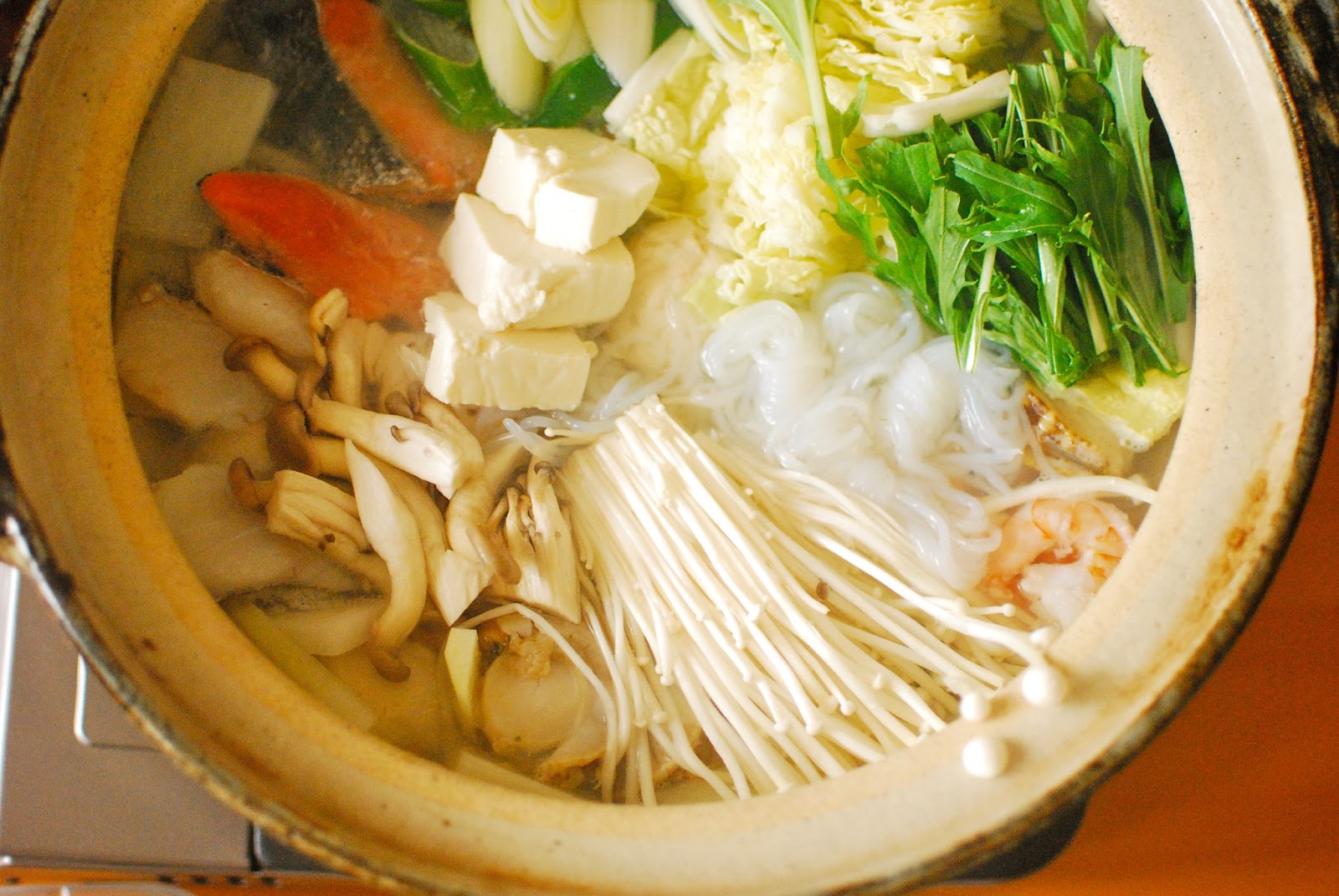
Nabe, traditionally Japanese cold-weather soup!
Nishi, Acivo, Des, Yukiko, Megumi, Fujimoto, Takamura, Jenny
home-made!
That night the volunteers hosted a dinner party at the missionary house. We cooked Gyoza (Chinese dumplings) for everyone. It was a nice gathering. Everyone was packed into a warm house, laughing and telling stories. It was more close, personal, and warm than the big Koinonia hall can be. 
Making a mess, per usual!
On Wednesday, I went with a fellow volunteer, Tsu-san, and the farm manager, Gussan, to the Rice Research Institute. We took 600kg of soy beans so that we could use their sorting machine. It took all day but was much faster than sorting by hand.

Next weekend, we'll be traveling back to Sanichi "Trinity" Church in Tokyo. We were invited to do a Lenten lecture about the YASC program. We'll send all your love to everyone we meet there. They are really just distant family, you know!

Back to nationalism. Some Japanese are worried that to solve the problem of a diving economy, Japan will again turn to militarism. I can sympathize and encourage them to continue to speak their mind. They are still on the other side of that line. 

I realize that I am from a country that spends a MIND BLOWING amount of money on its military. According to a press release from the Department of Defense on February 11th, President Obama sent Congress a proposed budget for the DOD of $525.4 billion. The release claims, "The proposed budget makes more disciplined use of defense dollars to maintain the world’s finest military and sustain U.S. global leadership." Our nation's leadership is dependent upon military action.

The word "control" comes to mind. While some Japanese are worried about starting down the path of militarism, my passport makes me a walking emblem of such a power structure. I don't know if I should feel shame or pride for the history of U.S. occupation of Japan. Part of that budget supports the continued occupation of Japan. 

I can only hope that our work here will be a small drop of water used to quell a raging fire. 

Peace be with us all,

Doug and Jenny Knight

Saturday, February 16, 2013

Home [(Fried Chicken) + (Winter=Mirkwood Forest) + (Comma Visits From) + (Lenten Observance)] = Is Where You Live

Last week I made fried chicken. Not because I love to eat friend chicken, but because it reminds me of home. Specifically, it reminds me of my dad and my in-laws. And Dad just recently had a birthday (February 15) so I decided to commemorate this by cooking food he would love to eat. Also, whenever we stay at the Knight house in Heber Springs, we can usually count on eating something fried and delicious (pork chops, deer steak, chicken, potatoes, egg rolls, etc!). I also made macaroni and cheese, not because it reminds me of home, but because I love to eat it! Okay, it reminds me of home too.


We've been thinking a lot about home lately. After graduating college and being gone for a year, it seems the homes we grew up in will officially be considered "our parents' houses." Our parents may not agree, but it's a line of thinking we can't help but accept. In one way, this is sad; there is a kind of grieving process that takes place over the loss of this idea of "home." But in another way, this is very exciting; we can start fresh, we can live wherever we want, we can do whatever we want, our slate is clean. We can build on a new idea of home. 

But right now, home is here. Home is at the Asian Rural Institute, and we are happy to be home. But just like at any home, with any family, we get frustrated, angry, uncomfortable, scared, annoyed, etc. These past couple of months have been especially cold and dark. We've always known that days grow shorter and nights grow longer in the winter, but it has never, ever affected us this strongly before. 

When we first arrived in August, the sun would rise over the mountains in front of our window and peak through our orange curtains. Around 6am, our room would be at its brightest, the sun shining straight through our sliding glass doors. We would finish evening work at 6pm (still light), go to dinner at 6:30pm (still light), leave around 7:15-7:30pm (still sort of light), try to go to sleep around 9:00pm (not quite dark). Maybe it was all the hard work, or maybe just the dark night creeping in on our day, but as the months drew on we began going to bed earlier. Since we've moved into the missionary house, we have been frightfully aware (afraid) of the dark. We closed the metal shutters on our bedroom window to try and conserve heat throughout the night, but this has only made our lives darker. We are compromising light for warmth, shouldn't these go hand in hand?

So the past couple of months, we have been waking up in the dark, spending all of daylight working at ARI, then walking home at 5:30pm (in the dark), showering, walking to and from dinner (in the dark), reading The Hobbit to each other (by lamp light) and of course, going to sleep (in the dark) at who knows what time anymore. We are probably the warmest when sleeping, at least there is that (as long as our faces are under the covers!). 

Needless to say, we have been struggling a little bit. I feel like Bilbo Baggins in The Hobbit: "This is the dreariest and dullest part of all this wretched, tiresome, uncomfortable adventure! I wish I was back in my hobbit-hole by my own warm fireside with the lamp shining!" It's hard to ignore the creature comforts when you're intimate with the elements like we are. 


But this adventure isn't wretched, tiresome, or uncomfortable. Well, yes tiresome, but so far it has been rich in love, support, incredibly wholesome and delicious food, and ARI as a whole is fertile ground for our food, learning, and our soul. We just have to remember and hold on to these thoughts when we are chilled to the bone, walking the long, dark road back to the cold and dark missionary house. 

But the Mirkwood Forest does not span all of Middle Earth. We are seeing signs of a new season: daylight is hanging around a little longer (hasn't quite made it to dinner yet) and there are daffodils sprouting around the campus. These observations have made all the difference in our daily life and attitude. We see ourselves slowly climbing out of this cold and dark place. Nishi also noted that Spring is near because the sunshine is now warm. If a Japanese person in Japan says Spring is near, I believe it! I thought we would be stuck in winter for the rest of our ARI days, but there is hope of warmth and light after all.


In other news, we would like to officially announce the visit of Doug's sister, Kimberly! She will come early June and stay for 5 weeks! And when we say goodbye in July, it will only be for 3-4 weeks. This blows our mind. We are super excited for Kimberly, she will have just graduated high school and be preparing for COLLEGE! We. can. not. wait.

Also, Doug and I have decided to take a week-long vacation and visit Thailand the second week of March. Since we are on this side of the world, we thought it would be worth our while to see and experience another country. It will also be nice to take some time for ourselves to rest and relax before the participants arrive and we begin the next phase of our ARI experience.

So with travels and visits to look forward to, as well as warmer weather and longer days, we feel it an appropriate and genuine time to observe Lent. We can quit thinking about how cold and miserable we are and reflect and focus on things that really matter. Like our own spiritual formation. We have been neglecting our relationship with God and others in our community. The choice to stay later after dinner and chat with our ARI family has been avoided to hurry back asap to the house and feel warmth without the looming fear of having to go back outside until tomorrow. But now, we literally have more time in our day to give to these relationships. We want to discipline ourselves to learn more about this place--our family here, sustainable food production, other cultures--all to bring us closer to each other and to God. 

These 6 weeks leading up to Easter, to the Resurrection of Christ, will coincide almost eerily to the arrival of this year's participants. When that time comes, the ARI community will most certainly be born anew. There will be more life here in so many ways: literally more lives will be present here, more cultures, more view points, more ways to live and love, more growth in food and in people, just more life. And until then, there will be quiet. We will cherish this quiet. We hope to be still, and to be quiet, and all the while, to be loving, and serving, and living together.

Thinking of home often,

Doug and Jenny 

Sunday, February 10, 2013

Happy Half-way Wonder

This Wednesday, February 6th, marked our six month that we have stayed in Japan. Jenny and I took the day off to reflect on what marks this time has left on us.
Our first day on the job!

We have met many different kinds of people from all over the world. Until now, countries like Uganda, Indonesia, and Brazil have only been a place on the map for us or a glossy picture in National Geographic. Here we have met Emma, Soni, and Joelma. We have experienced the human component of these places, which holds more meaning than a year of research could bring us.

People from the United States have also come here to volunteer. We have been surprised at just how different they can be from us even though we come from the same country.

The word "community," carries a more complex meaning for us now. We spend so much time working beside other members in our community and so little time relaxing. It can be lonely to realize that no one knows who we really are at home. How do you begin to reveal such things when shoveling manure or frying potatoes. It takes enormous effort to make and maintain the emotional connections that go beyond the day to day tasks that are required on this farm.

We are also realizing more and more what it means to be completely displaced from the community that we were born into. Since arriving in Japan, we have only met one person who is from Arkansas. Other than that, no one we met has ever even been there. Here, Arkansas seems to have little more relevance than a dream that we had long ago. Even advanced internet technologies can do little to bring that dream any closer. But through this displacement we are finding new value in our home community, and cannot wait to return.

We have been questioning the use of power. Humans use political power, economic power, military power, electrical power, and the power of fire arms to get what they want. We claim to be able to control such forces but events such as the Fukushima Di-Ichi power plant rupture and the shooting at Sandy Hook have moved us to pause and consider more carefully what power really is.

Time is also an interesting idea here. We sometimes feel like we arrived yesterday, setting our bags down with airport tags still on. At other times we feel like we've been here for years and years. It is hard to imagine that we have half our time to look forward to still. Who knows how slowly or how quickly it will seem to pass. When we return home, this will all likely feel like a dream we had while napping one August afternoon.


News on the Farm

Jenny has officially passed the ARI driving test. She is now a designated driver of the kitchen garbage route. This involves taking the blue van to pick up waste from tofu shops, the school lunch room center, and the super market. I am very proud of her, though I am scared even just riding in the car with her. Driving on the left side of the road is very intimidating to me. I am so absent-minded that I could get into trouble very quickly.

Long Caption Explanation:
The yellow bucket it full of fish that is not "consumer worthy." It is either old, irregular, too small, too big, etc for sale. We smoke the fish and use it as a protein source in our livestock feed; The blue crates are full of "okara," which is the byproduct of making tofu. We also use this okara as a protein source in our livestock feed. It is also used in one of our organic fertilizers, okara bokashi; There are plastic bags filled with bread. These bags come from the school lunch center (place where school lunches are made, assembled, packaged, and distributed to schools) and are leftover from the students' lunches. Each classroom collects leftover bread or rice and returns it to the center where we pick it up. We use the bread and rice to make okara bread (fermented okara and bread which goes into pig feed) and fermented rice, respectively; There are also plastic bags of vegetables. These also come from the school lunch center after preparing the food. Usually they are radish or carrot peels or leafy tops of radishes; And lastly, there is a box of single-serving milk cartons (like we are all familiar with). These are extra from the school lunch center and surprisingly they are weeks from expiration! We enjoy making yogurt, chai tea, cream sauces, etc with these milk rations. We collect all of these things on a daily basis and anything we are unable to use we send to the compost pile. It is one of the most important lessons that ARI tries to live out--using local resources. We base our feed formulas and our own diet on what we have available.

Today, we are in the middle of our English Work-Camp. Twelve Japanese people have come to visit ARI this weekend to learn about our farm and also to practice their English. We are explaining the philosophy of cyclical food production. As we show them around the farm and guide them through Foodlife work, we are pointing our many examples of this. From the "waste" food we feed to our livestock that Jenny picks up, to the soap that we use in the kitchen, which we make from used cooking oil, we strive to live in a cyclical way that reflects the very processes found in nature. Actually we just taught them all how to make soap using used cooking oil and caustic soda. They are currently learning how to make curry from our newly arrived staff member, Acivo.


Acivo is from northeast India, also called Nagaland. The people and their cultures are much different than what you typically think of when you hear about India. We had a participant from Nagaland last year, Chongli. In this area, there are many different cultures and languages spoken. Acivo can speak five dialects. She grew up in a very small village. When she returns to that village to visit her uncle who still lives there, she has to walk most of the way because the roads are not passable by car. She was a participant here in 2008 and now as staff she will be taking charge of the kitchen (she is Jenny's new "boss!")
Acivo & Nishi
I am beginning to get a whiff of the curry from the kitchen so I'm going to let you all go.

After working, the Japanese people usually turn to each other and say, "Otsukaresamadesta." This means something like, "Thank you for your hard work!" So to everyone who has supported Jenny and I throughout these six months with money, letters, prayers, emails, peanut butter, coffee, and chocolate, we would like to take a moment to turn to you and say, "Otsukaresamadesta!!!" Truly, our hard work would not be possible without all of the hard work you have given to us. Thank you very much!

May the Peace of Christ be with you,

Doug and Jenny Knight

PS. This weekend was the discernment weekend for young people looking at the YASC program. They are currently in Florida at Camp Weed, where we started this journey two years ago. They are having discussions that will change their life forever. Please hold them in your prayers!

Saturday, February 2, 2013

Wholesome Freedom

As promised, here's the scoop from the women's conference I attended last weekend!

This Women's Conference in Japan started back in 1957 when a group of missionary wives began gathering on an annual basis to celebrate and share in in fellowship with other women. The gathering has grown to include women from all over Japan, and not just those who are married or missionaries. For some years now, the Women's Conference has invited women from ARI and provided them with scholarship for the weekend.

So Kelly and I were invited to attend the conference this year, how exciting! Kelly handled most of the communication and planning, so it was nice just to be along for the ride and not have any expectations. We once again navigated the the incredibly complex yet user-friendly Japan Railways (JR), and after 8 hours on local trains, we arrived at Amagi Sanso, a lovely retreat center/hotel in the mountains of the Izu Peninsula. We got situated in our Japanese-style room with a tatami floor and futon bed :)

The theme for the weekend was "Treasuring Our Gifts" using scripture reading from 2 Corinthians 4:7  "But we have this treasure in earthen vessels, so that the surpassing greatness of the power will be of God and not from ourselves." The guest speaker was a woman named Lorelei Johnson VerLee. She grew up in a missionary family in Japan (now lives in Indiana with her family) and as an adult, has founded different organizations to empower women around the world through handicrafts. You can learn more about her and her work on her website. She shared her story of spiritual growth and discovering her gifts.

In our discussions with Lorelei, we especially dissected Romans 12:6-8 "We have gifts that differ according to the grace given to us; prophecy, in proportion to faith; ministry, in ministering; the teacher, in teaching; the exhorter, in exhortation; the giver, in generosity; the leader, in diligence; the compassionate, in cheerfulness." We talked about these specific gifts, what I would probably refer to as dominant personality traits, and what each one looks like today. After talking briefly about the possible negative consequences of each of these gifts, we were asked to break into small groups and come up with a skit to illustrate two gifts coming into conflict. In my group was Kelly, Lyn (a woman I met from Arkansas who I will tell you about later), and a Japanese woman named Masako, who knew very little English. Masako began by telling us a story (Lyn translated!). She often visited a park near her home, and occasionally saw people who were contemplating suicide, and once even witnessed suicide. This was clearly something that was heavy on her heart and she needed listening ears. At the same time, we were given only 15 minutes to come up with this skit. I most identified with ministry (or service, as it is called in some translations), and the general "downfall" of a person of this persuasion is always wanting things to be done the "right way" (I certainly fall into this category). So while I was trying to listen to Masako's story, I was also stressing that we were not making the best use of our time to create this skit. And it suddenly occurred to me that this is exactly the kind of situation where gifts can come into conflict with one another:

My desire to get things done was interfering with my ability to show compassion or mercy. It is a miracle to me that my small, one-tracked brain realized this in the moment of said conflict, and I was able to compromise my dominant desire to cut her story short and move on, in order to give her this space to lift her burden. When she had finished her story and we shared our condolences, we were all ready to move on. We did our skit on this very instance of conflict. 


The conference was set up like any typical retreat. There were these kinds of large-group presentations and discussions facilitated by different planning committee members, there were different workshops that we could attend, time for self-reflection and relaxation, etc. I attended two workshops, the first was on quilting! We were given material to make a small quilt (maybe 7in x 7in square) and learned how to line up the pieces, sew them together, and stitch with the batting inside. This was an incredibly fun and enlightening and all around wonderful workshop for me, a productivity fiend who loves to keep her hands busy and create many, many things. I was absolutely delighted with my final product, my first quilt! I gifted it to Nishi for her birthday!
Nishi cutting her birthday cake!

The second workshop I attended was on puppets and puppet ministry. The woman leading the workshop was truly gifted in puppeteering, she had the puppet characterization/voices, body and mouth movement, and the passion to pull it all together. She talked briefly about how puppets can be an incredibly effective tool for conveying messages and communicating effectively, especially with children. They give children a voice other than their own, for circumstances where a child might be embarrassed to tell a particular story or ask a certain question. Puppets are also good at conveying messages because people, adults and children alike, tend to remember the performance more so than they would a traditional sermon. We then picked out a puppet and began planning a skit for the closing worship service. Somehow, I managed to land the lead role in the skit, and I wasn't exactly confident about that. We began practicing and even after multiple attempts and silent motivational speeches to myself, I had to tell myself this just wasn't my gift. I handed over the role to someone else and took on a silent dancing role. This was hard to do, especially in front of people I barely knew. But I think recognizing those things that we are not gifted at is just as important as recognizing the things that we are. We all had a good time dancing with our puppets behind the curtain, and maybe dancing ourselves :)

(I'm the blue guy on the right!)
The absolute best part of this conference, for me, was not the guest speaker, was not the appropriate theme, was not the large-group discussions or skits, was not the snack table (which was pretty awesome)--it was meeting Lyn Sato. Lyn grew up in Arkansas, in Sherwood, Arkansas, to be exact, and in the Episcopal Church. She attended Sylvan Hills High School, a rival school of my high school, Wilbur D. Mills University Studies High School. and, And, AND, she was a counselor at Camp Mitchell (maybe early 80s?). What are the odds? She came to Japan with her husband and works as a teacher now. When we discovered we shared these southern roots, we started this weekend-long "do you know...?" game. We uncovered all these connections, laughing and crying over people loved and lost. Meeting Lyn in this foreign country, at this annual conference mountains far away from both our Arkansas home and current Japan home, was one of the most spiritually uplifting experiences I've had since I've been here. It reinforced for me who I am and where I come from, and seemed to legitimize my identity in this place. To other people, I am just a foreigner, or an American, or maybe even an Arkansan to those people who have actually heard of my state; but to Lyn, I was Jenny Knight, Maumellian (is that what we're called?), Wilbur D. Mills Alum, University of Central Arkansas Alum, Arkansas Episcopalian, Camp Mitchell counselor...all these things that are virtually meaningless to other people I meet here. 

Sidenote: A friend at Camp Mitchell painted a quote in our Arts & Crafts pavilion that I have never understood: "I am whole, I am free." (Cane West). I always thought it sounded too...something, beyond my rational scope of understanding. And I'm not sure if I have any better grasp on what Cane was meaning, but after last weekend, the quote has been popping up in my mind when I think about Lyn. Because since we met, I have felt, somehow, "free." And maybe it's because I feel I have been validated, maybe vindicated by her knowing and understanding my roots. Like I said, this might be far from what Cane was getting at, but I feel by recognizing and really understanding and empathizing with other people, we are freeing them from this feeling of not belonging or fitting in. Maybe the role that Lyn has played in my experience and existence in Japan is the role of assurance, and that, I feel, has completed this wheel of experience I've created in my brain to represent myself in this different culture. I am whole, I am free.

Kelly and I returned Sunday afternoon. We spent the entire train rides home dissecting all that had happened during the weekend. It was really nice for us to have been there together, I think we really bonded over some of the conference activities and our reflections of the weekend. So back at ARI, the "real-world," which still seems so unreal to both of us, we are adjusting back to farm life and kerosene heaters. Kelly arrived just one month after Doug and I, she will stay at ARI until January 2014. As for Doug and I, we are days away from the half-way mark. February 6 is our 6-month ARI anniversary! 6 months down, 6 months to go. Even though our time here will begin "counting down," we are certainly still in the mindset of "counting up." In the next month or two we will be preparing for the new 2013 participants' arrival and the busy spring and summer work that lies ahead. Even though we feel we know the ropes most of the time, it is humbling to think that we have no idea what is about to blossom on this farm in the next few months. A new season brings new work, and new lessons to be learned. We are very excited!


Knight Field Update

Well, our field has seen a good number of snows this winter, but we think it will pull through. We've already stepped on our wheat and now we can sit back and wait for the warmer sunshine of spring to really spur the growth of our strong little sprouts.


Edo Wonderland

Yesterday we visited Edo Wonderland, a theme park celebrating the Edo era in Japan, 1603-1868. We saw ninja shows and reenactments and wax museums and all sorts of theme park-related fun. I will let the pictures do the talking (especially since I have done so much talking already!)


Ninja training

contemplating in the maze

throwing ninja stars!
Fellow Servants in Christ,

Doug and Jenny

Sunday, January 27, 2013

Peanut Butter Crackers

 Hello! Doug here. Jenny is currently riding a "shinkansen" (the fast one) back to ARI! I have been on my own all weekend. Jenny has been at a conference in another city. It was a conference for women so naturally, I wasn't invited. I wasn't too hurt. I spent the weekend cleaning house and just relaxing. We stay so busy that we have no time to clean anything during the week. So while the wild girl that always fills my weekends with plans is gone, I have cleaned nearly everything here. I have done dishes, laundry, swept up the dust bunnies, and scrubbed the mold off the shower.

I have come to realize that cleaning you surroundings is like a sort of meditation. In order for your mind to be clear and at peace, your surroundings must be clear and at peace also. I have cleaned the whole house and my mind is nearly as clean.

Here at ARI we have had some really nice meals. There has only been six or seven people at each meal so we've all been at one table. It felt like a meal at home!

I spent all day Friday missing Jenny and tending to onions. Onions are hard to grow. We plant them in November and harvest in June. They need as many hours of daylight as possible so that the bulb can grow. They are just the size of chop sticks now. When it gets really cold here, the water in the soil freezes and pushes up to the surface. This causes the onion seedlings to pop out of the soil. So we have to go and squat next to each one, put it back in the frozen soil, and add mulch to keep it warm. I did this all day. My back is now in the shape of a question mark. What? Yes, a question mark.

I've decided to make this week's blog short and leave you with a few good pictures from our experience here!

Katie, Jenny, Kelly, and Leo below the Tokyo skyline. 
Me riding a bike through the rice fields. I miss the summer!
I am a master chef.
Winter hiking.
My beautiful wife and her be-loved co-worker, Nishi. They are the cutest! (Nishi's birthday was Saturday!)
Stay tuned next week for Jenny's report on the Women's Conference and the adventures that await us this coming week!

Your brother in Christ,

Doug